02 Sep 2026 Blogs
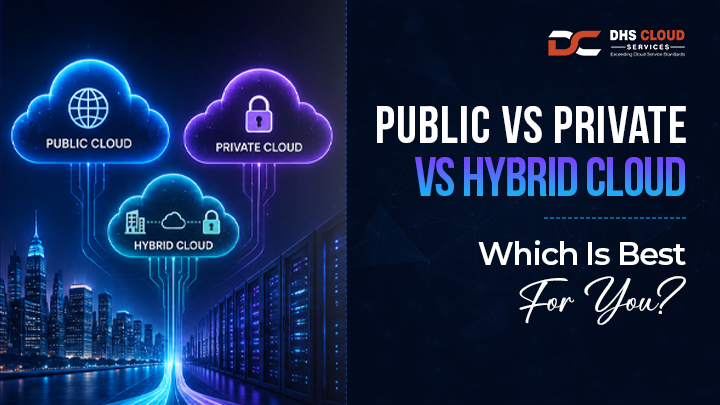
Picking a cloud model is almost like hunting for houses. Do you rent an apartment and share the building with others? Buy your own place and control every wall? Or do a piece of both? That's really what public, private and hybrid cloud services mean too.
This choice matters more than people think. One wrong choice and you are paying for space you don’t use or you run out of space right when the business needs it. So, you should be cautious of your decision.
There are three main types of cloud computing: public, private and hybrid. None of them is best alone. It all depends on your workload, your budget, compliance rules and how fast you're growing.
Here is a quick definition for all three types of cloud computing.
Public cloud gives you scale; private cloud gives you control, and hybrid tries to provide you both.
|
Factor |
Public Cloud |
Private Cloud |
Hybrid Cloud |
|
Infrastructure |
Shared |
Dedicated |
Combined |
|
Cost |
Lower entry cost |
Generally higher |
Depends on setup |
|
Scalability |
High |
Depends on infrastructure |
High |
|
Control |
Moderate |
High | High |
|
Customization |
Moderate | High | High |
|
Security control |
Shared responsibility |
Greater organizational control |
Flexible |
|
Best for |
Variable workloads |
Sensitive workloads |
Mixed workloads |
One thing worth clearing up early: no model is "more secure" just by default. Security really comes down to how it's set up, not which box you tick.
Think of it like an apartment building. Everyone shares the same building and the same security desk on the ground floor but your apartment is still locked and private to you.
It's shared infrastructure, managed by the provider, priced accordingly and it scales fast when you need it to.
Why businesses like it: lower cost at first, quick scaling, faster setup, and access to managed services (ready-made tools the provider looks after for you), so you're not stuck fixing hardware.
When does it make sense? It is best if:
Now imagine you own a house instead. You decide who gets a key, how the rooms are arranged, and what type of locks will be on the doors.
That's a private cloud. Solid infrastructure, full managerial control, and the freedom to customize different things.
The benefits: custom security setups, better alignment with regulatory needs, more space to customize workloads, and management that's easier to predict since nothing is shared.
When should you choose a private cloud? When you're handling sensitive data, when compliance rules are non-negotiable, or when your applications genuinely need dedicated resources.
Hybrid cloud is basically a mix of both options. It combines public and private environments. In it, businesses can put different workloads exactly where it belongs. Sensitive data stays private, scalable stuff runs on public cloud and good networking holds these two together.
Why hybrid cloud? More flexibility, resources that scale when needed, the right infrastructure for the right job, and a smoother path if you're migrating old systems (legacy infrastructure) bit by bit instead of all at once.
The Need: an accounting firm keeps client financial records secured in a private cloud for peace of mind and compliance. But when tax season comes, their client portal suddenly gets a lot busier, they lean on public cloud to handle that extra load without slowing down. That's hybrid cloud on the job.
A cloud computing server is what actually gives you the horsepower behind any of these models. It provides processing power, memory, and storage. It lets you run apps and save data.
Go for Public Cloud if: cost matters most to you, you need to scale fast, your workloads keep changing, or you'd rather not manage infrastructure at all.
Go for Private Cloud if: control is non-negotiable for you, your data is sensitive, or compliance is really strict.
Go for Hybrid Cloud if: you want both scale and control, you have both sensitive and otherwise workloads, or you're moving old systems over gradually.
Before opting for any type of cloud model, you should ask yourself these questions.
Answer these honestly, and the right model will become obvious for you.
Choosing and managing the right cloud setup gets easier with the right partner. Here's how we help:
We don't just provide infrastructure; we help you figure out what you actually need first.
At the end of the day, public, private and hybrid clouds each solve different problems. There's no universal winner here, only what fits your workloads, your budget, and your comfort with control versus convenience. Your cloud model should support your business and not cause another set of troubles for you. If you are not sure about the correct cloud model, then you can have a talk with our team. We are happy to help you.
Public cloud often works well because of lower management effort, but it really depends on your data and compliance needs.
Not automatically. It's about configuration and monitoring, not the model itself.
A mix of public and private, keeping sensitive data private while scaling other workloads on public cloud.
A machine delivering processing power, memory and storage over the internet, so you skip owning physical hardware.
Absolutely. Cloud strategies aren't set in stone; they shift as your needs do.