08 Oct 2026 Blogs
Looks like you are confused between VPS and Cloud Hosting Services? That’s a tough call especially when both these words are used interchangeably. Both of them are good choices but they work and deliver things differently. And this difference matters for your business because of different aspects like performance, scalability, dependability, security, control, and cost.
The best option depends more on your workload, how your traffic behaves, business objectives, and the management capacity of your IT staff. This blog is all about helping you make the best decision in this matter.
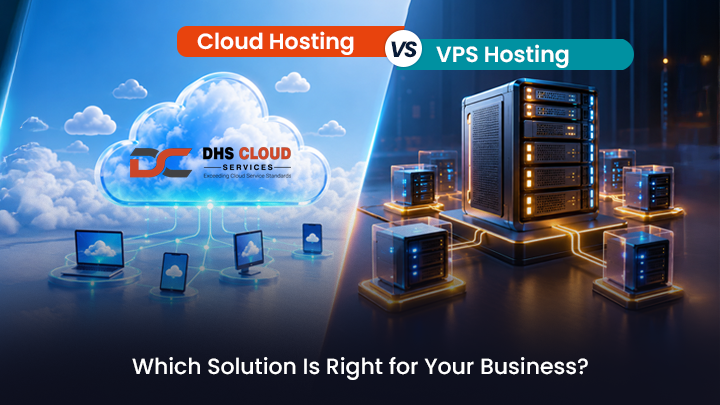
Cloud Hosting Services deliver resources through a network of interconnected servers working together as one pool. VPS Hosting takes a single physical server and splits it into isolated virtual environments each with its own dedicated slice of resources.
That's the core architectural difference and it shapes almost everything else: how each option scales, how reliable it is, and how much control you get.
Cloud Hosting: Multiple Interconnected Servers → Shared Infrastructure Pool → Flexible Resource Allocation
VPS Hosting: One Physical Server → Multiple Isolated Virtual Servers → Dedicated Allocation
Cloud Hosting Services generally offer more scalability and infrastructure flexibility. VPS Hosting gives you a more predictable, isolated environment with tighter control over a fixed set of resources.
|
Factor |
Cloud Hosting |
VPS Hosting |
|
Infrastructure |
Multiple connected servers |
One physical server divided into VPS instances |
|
Scalability |
High |
Usually more limited |
|
Availability |
Generally higher |
Depends on the physical host |
|
Resource allocation |
Flexible |
Fixed/dedicated |
|
Control |
High, depending on provider |
High |
|
Performance |
Suited to variable workloads |
Predictable for stable workloads |
|
Cost model |
Often usage-based |
Usually, a fixed plan |
|
Best suited for |
Growing or variable workloads |
Stable, predictable workloads |
Cloud Services are generally more scalable because resources can scale across a distributed infrastructure, not just one machine. VPS Hosting can be upgraded too, but it's limited by the capacity of the physical server.
A few things that you must know.
If your business expects real growth in the next year or two, scalability isn't a nice to have thing. It's the whole point.
Performance depends on your workload and how the provider configures things. Cloud hosting offers stronger resilience for workloads that need flexible resources and don't want to depend on a single physical server.
A few factors to keep in mind:
Honestly, uptime percentages on a sales page don't tell the whole story. What actually matters is the provider's SLA, their Redundancy Architecture, and how fast they can Recover If Something Goes Wrong. If disaster recovery is a priority for your business, then you must look into dedicated disaster recovery services before committing to any option.
Both Cloud Hosting and VPS Hosting can be secure for you as long as they're configured properly. Security has less to do with the hosting model itself and more to do with access controls, encryption, monitoring, patching, backups, and compliance practices.
For security, you can look into these things:
To ensure proper security standard, these are a few frameworks that you should know.
Not necessarily and this is where a lot of people get it wrong. VPS Hosting can be more predictable for stable workloads. Cloud Hosting can actually be more cost-efficient when your resource needs fluctuate.
Overall, below are the things that affect your real cost:
Businesses should look at Cloud Hosting Services when they need scalable infrastructure, high availability, flexible resources, or a setup that can handle changing workloads without breaking a sweat.
Choose Cloud Hosting when:
VPS Hosting works well for businesses with predictable workloads that want an isolated environment, dedicated resources, and strong server-level control without taking on the complexity of a larger distributed setup.
Choose VPS when:
If you're after virtual private hosting with a smaller footprint and simpler management, VPS is the practical, problem-free choice you can make.
The best choice comes down to how your workload behaves, your scalability needs, availability expectations, security requirements, budget, and how much technical management you're prepared to take on.
Going through these five steps gives you a clear, practical way to decide, instead of just guessing based on price alone.
Cloud Hosting is generally the stronger pick for businesses that care most about scalability, flexibility, and resilience. VPS Hosting suits businesses that want predictable resources and tighter control within a defined environment. Ultimately, the right decision depends on your workload, growth plans, security needs, and budget.
Quick decision summary:
Whichever path fits your business, getting the infrastructure right from day one saves you a lot of headaches down the road. If you're still weighing your options, it helps to talk through your specific workload with a team that manages both cloud and VPS environments day in and day out.
It depends on your needs. Cloud hosting is better for scalability and flexibility, while VPS hosting is better for predictable, stable workloads with tighter control.
Yes, migration is possible, though it usually requires planning around data transfer, downtime, and application compatibility.
Not always. VPS can be cheaper for stable, predictable needs, but cloud hosting can actually save money when your usage varies a lot.
No. Security depends on how the environment is configured, including access controls, encryption, and monitoring, not just the hosting model itself.
Cloud hosting usually works better here because it handles traffic spikes (like during sales) more smoothly than a fixed VPS setup.
A cloud server pulls resources from a network of multiple machines. A VPS server runs on one physical machine split into isolated virtual sections.
Yes, especially for small businesses with steady traffic and simpler applications that don't need constant scaling.
Look at your workload type, how much your traffic changes, your growth plans, and your budget. The 5-step framework above is a good place to start.