28 Apr 2026 Blogs
With businesses moving towards digital-first operations, the importance of reliable and scalable hosting has never been more important. Conventional hosting environments can hardly sustain growing traffic, performance requirements, and security needs. That is why many organizations are turning to a trusted cloud services company to migrate their websites to the modern cloud infrastructure.
With providers like DHS Cloud Services offering a 99% uptime guarantee with SLA-certified performance, businesses can safely move to the cloud. In this blog, we will go through the process of moving a website to a cloud-based server hosting and the benefits you can expect.
Cloud-based server hosting is different from traditional servers. With it, businesses can enjoy adaptable resources, enhanced uptime, and performance without having to invest in physical infrastructure.
A trusted cloud services company offers flexible environments where websites can manage fluctuating traffic, operate at a better speed, and can be accessed anywhere. Businesses benefit through operational efficiency and cost control with features like resource scalability and centralized management.
The first step in migrating your website is to understand what you have at present. This includes an analysis of server specifications, website sizes, database structure, traffic patterns, and any third-party integrations.
This analysis helps in identifying the right cloud setup to use. Regardless of whether your website is simple or a complex application, with the right planning, the migration will be a smooth process.
At this stage, professional cloud management services can be very beneficial to businesses. This is because their services can be used to determine the resource requirements and identify possible risks before migration.
Choosing the right cloud environment is essential in terms of performance and cost-effectiveness. A trusted cloud services company like DHS Cloud Services will provide customized hosting plans depending on your workload. This way, you will only pay what is required.
Some factors you should consider are CPU performance, RAM allocation, the type of storage (SSD-based for faster processing), and the bandwidth. Selecting the proper plan will make sure that your site works optimally once migrated.
DHS Cloud Services offers infrastructure hosted on Tier 3 data centres. This provides high reliability and stable performance, which is crucial for business-critical websites.
It is important to make a full backup of your website before starting the migration. This includes website files, databases, configurations, and any related applications.
A safe backup will guarantee that in case of unforeseen circumstances during the migration, your data will still be safe. Professional cloud management solutions usually have automated backup plans, which provide an additional level of security to the process.
After finalizing your hosting plan, the next step is to set up the cloud server. This includes configuring the operating system, installing the necessary software, setting up databases, and preparing the environment for deployment.
With cloud-based server hosting, this process becomes quicker and more efficient as opposed to traditional setups. DHS Cloud Services provides optimized server configurations and a high-availability (HA) environment. This means that your website will not be down even if one of the servers has a problem.
Such a high degree of infrastructure reliability will greatly minimize the risk of downtime during and after migration.
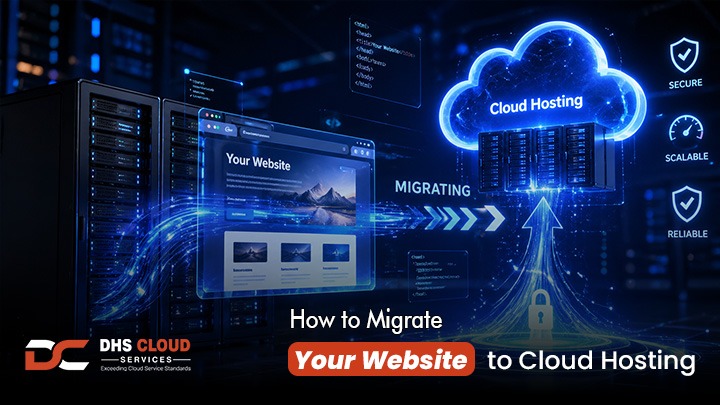
Once the cloud environment is ready, the actual migration starts. Website files and databases are moved out of the current server to the new cloud server.
This may be carried out either manually or by automated tools, depending on the complexity of the website. A professional cloud services company ensures that data integrity is maintained during the transfer process and issues like data corruption or loss of files are prevented.
You should ensure that you test your website properly before it goes live on the new server. This involves testing the functionality, loading speed, database connectivity, and cross-platform and cross-browser compatibility.
Testing will also ensure that your website works as intended in the new cloud-based server hosting environment. It also helps in detecting and fixing any problems before the users experience them.
With the help of cloud management services, businesses can also track performance metrics and optimize configurations to achieve the best outcomes.
After testing, the last step is to update your domain’s DNS settings to refer to the new cloud server. This is done to redirect traffic from your previous hosting environment to the new one.
DNS propagation might take some time, but with a good cloud services company, the downtime can be minimized. DHS Cloud Services provides a seamless migration, backed by infrastructure designed to support uptime and performance.
In fact, our 99% uptime guarantee and SLA-backed performance ensure that businesses have consistent website availability even after migration.
Migrating to cloud-based server hosting has many other long-term benefits apart from better performance. Scalability is one of the greatest benefits. Your hosting environment can be expanded as your business grows without you having to upgrade the hardware.
Another significant advantage is security. Cloud environments have advanced firewalls, encryption, and monitoring systems, so your data and applications are always safe.
Also, companies get access to professional cloud management solutions, which make server maintenance, updates, and monitoring easier. This helps in easing the pressure on internal IT teams and enables businesses to focus on growth.
DHS Cloud Services makes this experience even better with on-time support and a turnaround time (TAT) of only 15 minutes. This ensures that any technical problems will be resolved quickly and efficiently.
Migrating your website to the cloud is an amazing strategic move that will give you better performance and security. However, selecting the right partner is equally important as the migration process itself. Among the crowd, DHS Cloud Services stands out as a reliable cloud services company that provides unmatched cloud hosting experiences.
Our infrastructure is built on enterprise-grade systems, including Tier 3 data centres and HA environments, which gives stability and reliability to businesses. We provide proactive support and constant monitoring to ensure that your website is always secure and functioning.
So, if you’re planning to upgrade your hosting environment, contact us today and migrate your website to experience the true potential of cloud technology.