08 Apr 2026 Blogs
Financial data sits at the centre of how a business operates. When it is inaccessible, delayed, or lost, the consequences ripple through every department. Accounting teams spend hours reconciling versions, business owners make decisions without current numbers, and auditors find themselves waiting on files that should have been ready days ago. This is the reality for most businesses still running Tally on a local desktop or an in-office server.
The shift toward cloud-hosted accounting is not a new idea, but the reasons businesses are actually making the move have become far more practical. The tally on cloud benefits goes beyond simple convenience. They address real gaps in how accounting infrastructure has traditionally been set up, gaps around access, data safety, system reliability, and the ability to support more than one person working at the same time.
This blog covers what those benefits actually look like in practice, how a cloud server for Tally works, and what businesses gain by moving to a properly managed cloud environment.
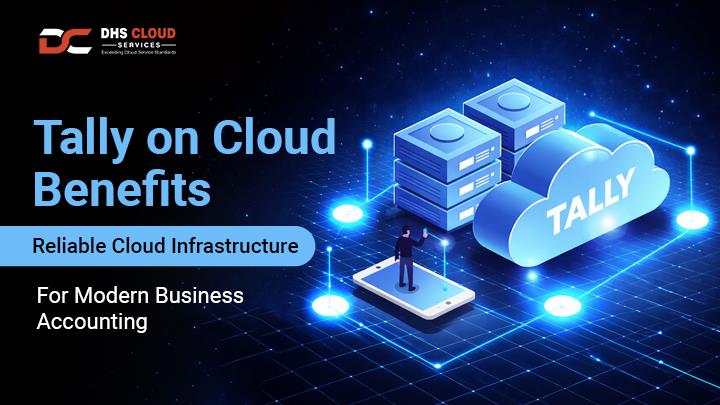
When businesses talk about Tally on cloud, they are referring to hosting the Tally software and all company data on a remote server rather than on a physical machine inside the office. The accounting environment lives on a cloud server for Tally that can be reached through any internet connection, from any device, by any authorised user.
In practice, this means the accountant does not need to be sitting at a specific computer. The business owner can pull up reports from another city. An external auditor can log in during a review without needing someone to email them exports. Everyone accesses the same live data, at the same time, without any of the file-sharing workarounds that most teams rely on today.
The difference from a traditional setup is significant. A local Tally installation is tied to one machine. When that machine is off, inaccessible, or damaged, the accounting work stops. A cloud server for Tally removes that single point of failure entirely.
Businesses moving to a cloud server for Tally immediately notice the flexibility it provides. Teams working from multiple locations, remote employees, and travelling business owners can all access the same accounting environment without transferring files or waiting for office access. The data stays live and synchronised, allowing multiple users to work on the same company file simultaneously without network limitations.
Security and reliability are also significantly stronger with a cloud server for Tally. Unlike local systems that are vulnerable to hardware failure, theft, or accidental deletion, cloud environments provide encrypted connections, automated daily backups, and controlled user permissions. In addition, cloud infrastructure runs on enterprise-grade servers with high uptime, ensuring that accounting data remains accessible even during local power outages or hardware issues.
Finally, businesses benefit from a more predictable cost structure. Instead of investing in local servers, hardware upgrades, and IT maintenance, cloud hosting converts accounting infrastructure into a manageable monthly expense while still delivering higher performance and reliability.
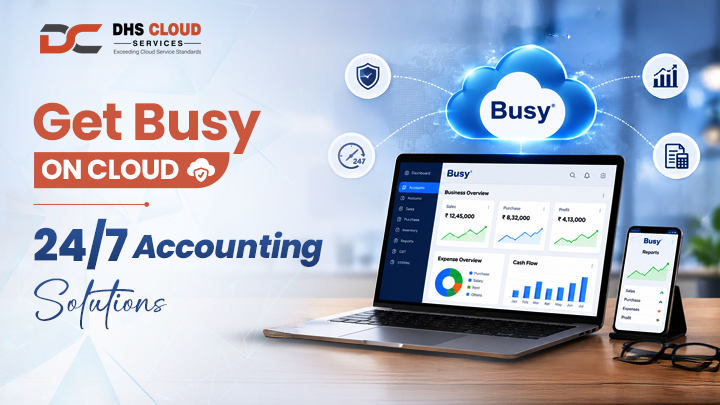
Not every Indian business runs Tally. Busy accounting software has a strong user base, particularly among trading businesses and those who prefer its GST-focused workflow. Busy on cloud works on the same principle; the software and data move to a cloud server, and users connect remotely rather than through a local installation.
The tally on cloud benefits described above applies equally to busy on cloud. Remote access, data protection, multi-user support, and system reliability are not features that belong to one accounting platform. They come from the infrastructure underneath, not the software on top.
For businesses evaluating their accounting setup, the choice between Tally and Busy is separate from the decision to move to the cloud. Both can be hosted on the same type of managed infrastructure, and both benefit from it in the same ways.
Hosting Tally on a cloud server is one thing. Having that server professionally managed is another. Managed cloud services mean that a dedicated team handles the ongoing technical work of keeping the environment running, security patches, performance monitoring, backup verification, software updates, and issue resolution.
For most businesses, this distinction matters more than it appears at first. Setting up a cloud server is not complicated. Keeping it secure, optimised, and running without interruptions for months and years requires consistent technical attention. Without managed cloud services, that responsibility falls on whoever is available internally, and for most accounting-focused businesses, that is usually no one with the right background.
Cloud managed services also cover the points of failure that businesses do not think about until something goes wrong. Are the backups actually completed? Is the backup restorable? Has the server had its security patches applied this month? Is the Tally licence about to expire? These are the kinds of questions a managed provider tracks continuously, so the business does not have to.
Scalability is the other dimension where managed cloud services make a practical difference. A business adding five new users, opening a second branch, or moving into a new financial year with larger data volumes should not need to plan a server migration. A managed provider handles resource scaling without disrupting ongoing operations.
Local accounting infrastructure has a fixed ceiling. At some point, the hardware cannot handle more users, more data, or more concurrent processes without slowing down or failing. Cloud infrastructure does not have that ceiling in the same way. Resources can be expanded as the business grows without replacing physical equipment or migrating to a new environment from scratch.
For businesses managing multi-branch operations or those going through a period of rapid growth, this flexibility removes a recurring constraint. The accounting system scales alongside the business rather than becoming a bottleneck that holds it back.
This is particularly relevant during high-activity periods, GST filing deadlines, year-end closing, or audits, when the accounting team needs to work at full capacity and cannot afford slowdowns from an overloaded local server.
Moving accounting infrastructure to the cloud is a decision most businesses end up making eventually. The tally on cloud benefits, reliable access, stronger data security, multi-user collaboration, and professional infrastructure management are not features that only large enterprises need. They matter for any business where accounting continuity, data integrity, and team coordination are important.
At DHS Cloud Services, businesses get access to a dedicated cloud server for Tally or Busy, backed by fully managed cloud services that handle the technical side completely. The infrastructure is built for accounting workloads, the support team understands both the software and the server environment, and pricing is structured to make cloud hosting accessible at every stage of business growth.
Whether the business is running Tally ERP 9, Tally Prime, or Busy, DHS Cloud Services provides the cloud-managed services that keep accounting operations running reliably, securely, and without interruption.